
Morocco 5 Day Itinerary: The Route We Actually Drive
Planning a Morocco 5 day itinerary and trying to work out whether it is worth it? Short answer: yes, if you pick one route and commit to it. Five days is enough to cross the High Atlas, sleep in the Sahara and still have a proper day in Marrakech. It is not enough to add Fes, Chefchaouen and the coast on top, and the trips that try usually turn into a week in a car.
We are Morocco Stunning Tours, a Berber family that runs private trips out of Fes and the desert near Rissani. The route below is the one our drivers actually drive, written the way we would explain it to you on the phone — including the parts that are hard work.
Is 5 Days Enough for Morocco?
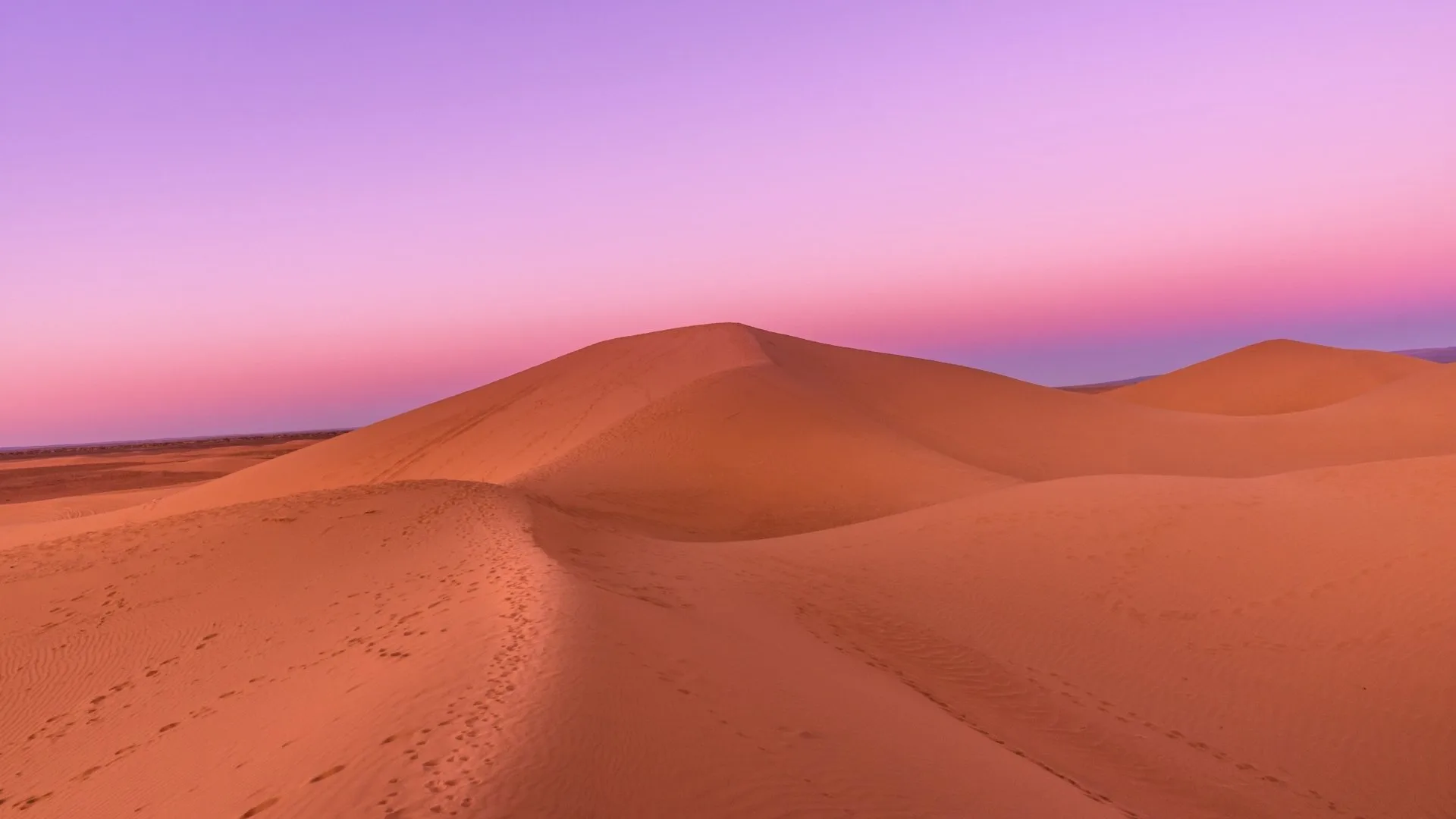
Yes — for one region, done properly. Five days covers Marrakech, the Atlas Mountains, Ait Benhaddou, the gorges and a night in the Sahara at Merzouga. That is a complete arc: city, mountains, kasbahs, desert.
What five days does not cover is the whole country. Morocco is bigger than most people expect — Marrakech to Fes alone is a full day of driving. If your list includes Fes, Chefchaouen and Essaouira as well, you need eight to ten days, or you need to drop something. We would rather tell you that now than have you spend your holiday watching the road. A Morocco 5 day itinerary works because it is focused, not because it is crammed.
What you can comfortably do in five days
- A full day in the Marrakech medina, souks and gardens
- The Tizi n’Tichka pass over the High Atlas, just over 2,200 metres
- Ait Benhaddou, the UNESCO-listed ksar, with time to walk up to the granary
- Todra Gorge and the Dades valley kasbahs
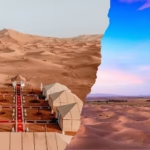
- A camel trek into Erg Chebbi and a night at a desert camp
- Sunrise over the dunes before the drive back
What we would leave out
- Fes. Beautiful, and a full day away from this loop. It belongs in a 7–10 day trip — see our Morocco tours from Fes if you would rather start there.
- Chefchaouen. Six hours north of Fes. Lovely, and impossible here.
- Essaouira. Worth two slow days, not a rushed afternoon.
The Morocco 5 Day Itinerary at a Glance
| Day | Route | Time on the road | Where you sleep |
|---|---|---|---|
| 1 | Arrive Marrakech — medina, souks, Djemaa el-Fna | None | Riad in the Marrakech medina |
| 2 | Marrakech → Tizi n’Tichka → Ait Benhaddou → Ouarzazate → Dades | About 7 hours with stops | Kasbah hotel, Dades valley |
| 3 | Dades → Todra Gorge → Ziz valley → Merzouga → camel trek | About 5 hours | Desert camp, Erg Chebbi |
| 4 | Sunrise in the dunes → Khamlia → back west to Ouarzazate or Skoura | About 6 hours | Kasbah hotel or Ouarzazate |
| 5 | Return over the Atlas to Marrakech and departure | About 4 hours | — |
You can run this Morocco 5 day itinerary in reverse, or finish in Fes instead of returning to Marrakech. Finishing in Fes saves you the long westward drive on days four and five, and it is what we usually suggest if your flights allow it.
Day 1 — Marrakech: Medina, Souks and Djemaa el-Fna
Morning: land, then slow down
Most flights arrive in the morning. We collect you and take you to your riad, and our honest advice is to do very little for the first few hours. Marrakech is loud, hot and disorienting on arrival, and travellers who sprint straight into the souks usually hate it. Drink a tea on the roof. Then start.
Afternoon: Koutoubia, Bahia Palace and the souks
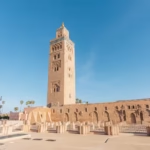
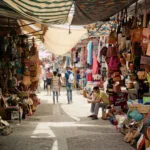
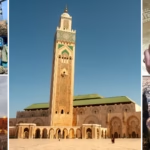
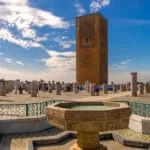
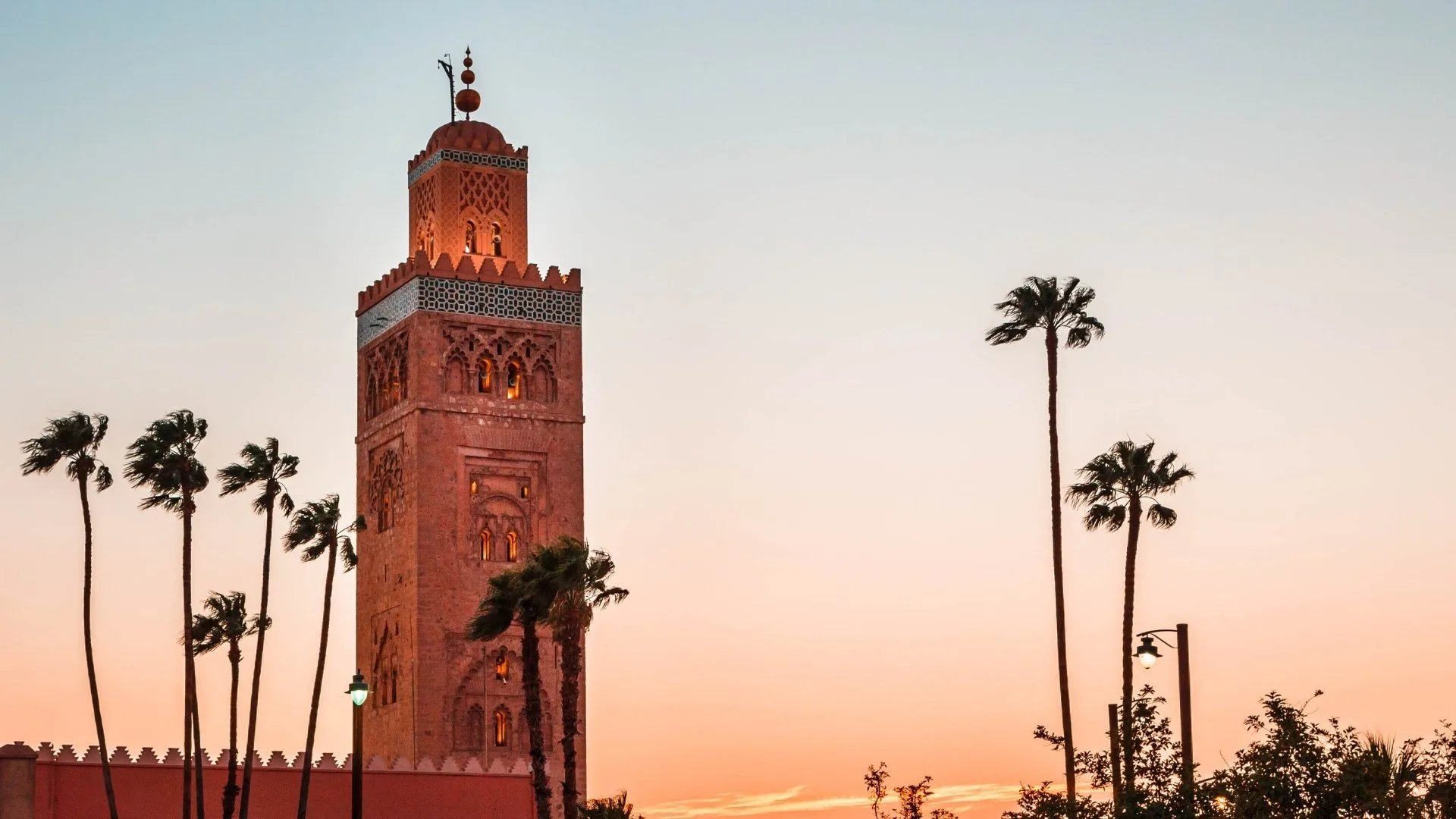
The Koutoubia minaret is the tallest thing in the old city and the landmark you navigate by. From there it is a short walk to the Bahia Palace, a 19th-century courtyard palace with painted cedar ceilings and enough shade to sit in. Then the souks. Go in with your guide the first time — not because it is dangerous, it is not, but because the lanes fold back on themselves and the first hour alone is usually spent being lost and slightly annoyed.
If you would rather have gardens than shopping, the Majorelle garden and the Secret Garden are both calm, and both busy at midday. Early or late is better.
Evening: Djemaa el-Fna
The main square fills up after dark with musicians, storytellers and food stalls. It is genuinely a spectacle and it is also a working tourist economy — expect to be asked for money if you photograph a performer, which is fair enough. Eat before you go, or eat at a rooftop overlooking it. We do not send guests to the food stalls in the middle of the square; the small restaurants a street back are better and calmer.
Where you sleep, night 1
A riad inside the medina. Six to ten rooms, a courtyard, a roof terrace. Cars cannot reach most riad doors, so you are met at the nearest gate and someone takes your bags the last stretch by cart.
Day 2 — Over the Atlas to Ait Benhaddou and the Dades
Leave early. This is the longest day of the trip and the one people underestimate. Out of Marrakech by eight at the latest.
The Tizi n’Tichka pass
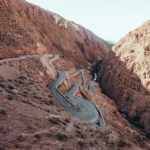
The road climbs to just over 2,200 metres through Berber villages built into the hillside, with walnut groves in the valleys and switchbacks the whole way. It was widened and resurfaced in recent years, so what used to be a punishing drive is now one of the best roads in North Africa. If anyone in your group gets carsick, this is the morning to take something for it. We stop wherever the view earns it.
Ait Benhaddou
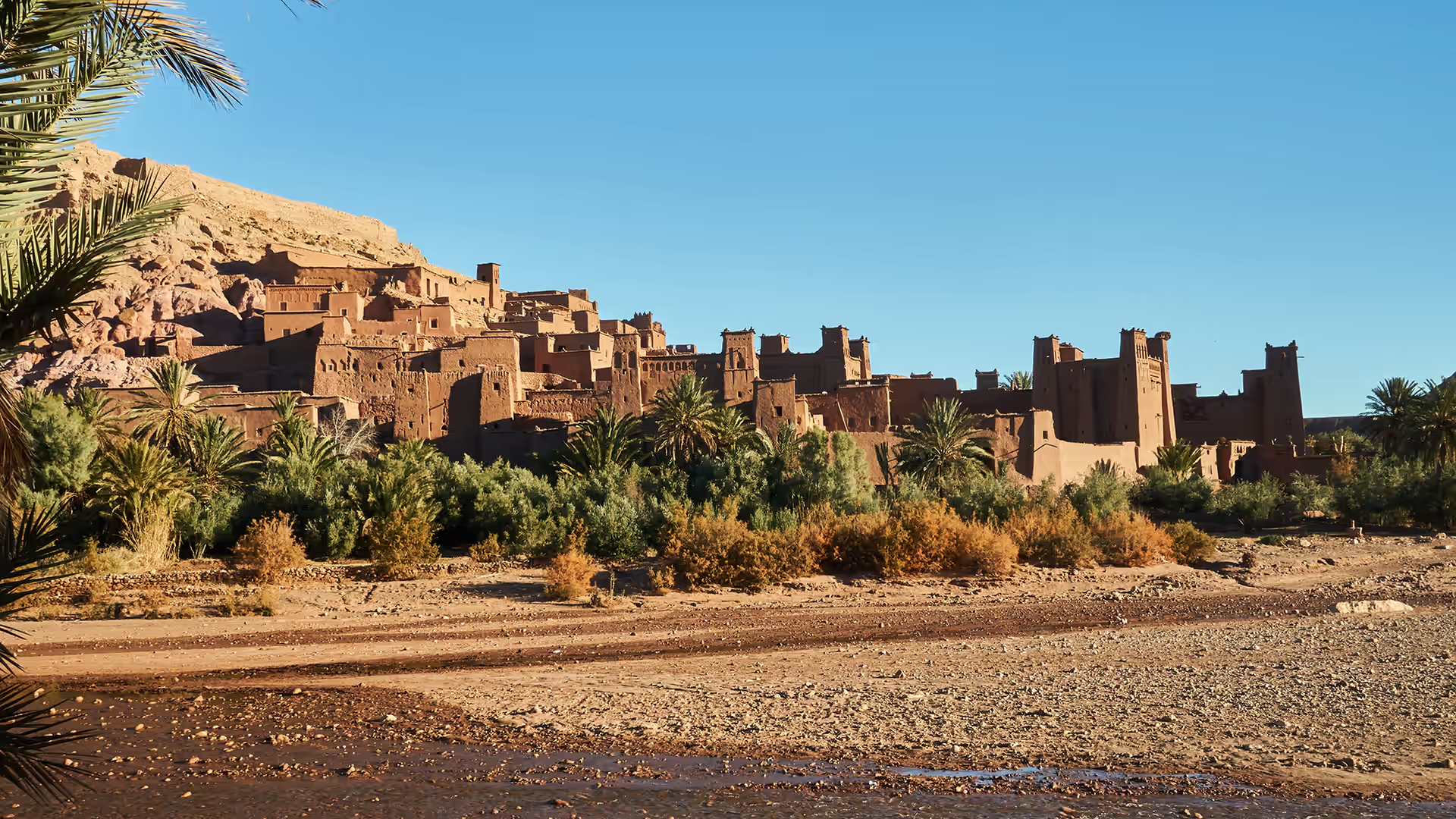
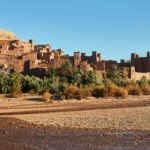
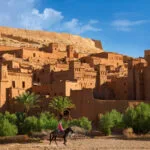
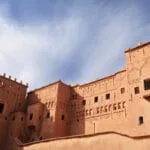
The UNESCO-listed ksar of Ait Benhaddou is the most striking earthen village in Morocco, and the reason half of Hollywood has filmed here — Lawrence of Arabia, Gladiator, The Mummy, Game of Thrones. Cross the river, climb up through the lanes to the granary at the top, and look back down the valley. A few families still live inside the walls.
Time it for late afternoon if you can. In the middle of the day the light goes flat, the earth walls lose their colour and the heat is punishing.
Ouarzazate and on to the Dades
Half an hour further on, Ouarzazate is the film town — Atlas Studios, the Taourirt Kasbah, and not much else demanding your time. Most guests stop briefly and push on east into the Dades valley, where the road runs past palm groves and half-collapsed kasbahs. Sleeping in the Dades rather than Ouarzazate shortens tomorrow and puts you somewhere far prettier.
Day 3 — Todra Gorge, the Ziz Valley and Into the Sahara
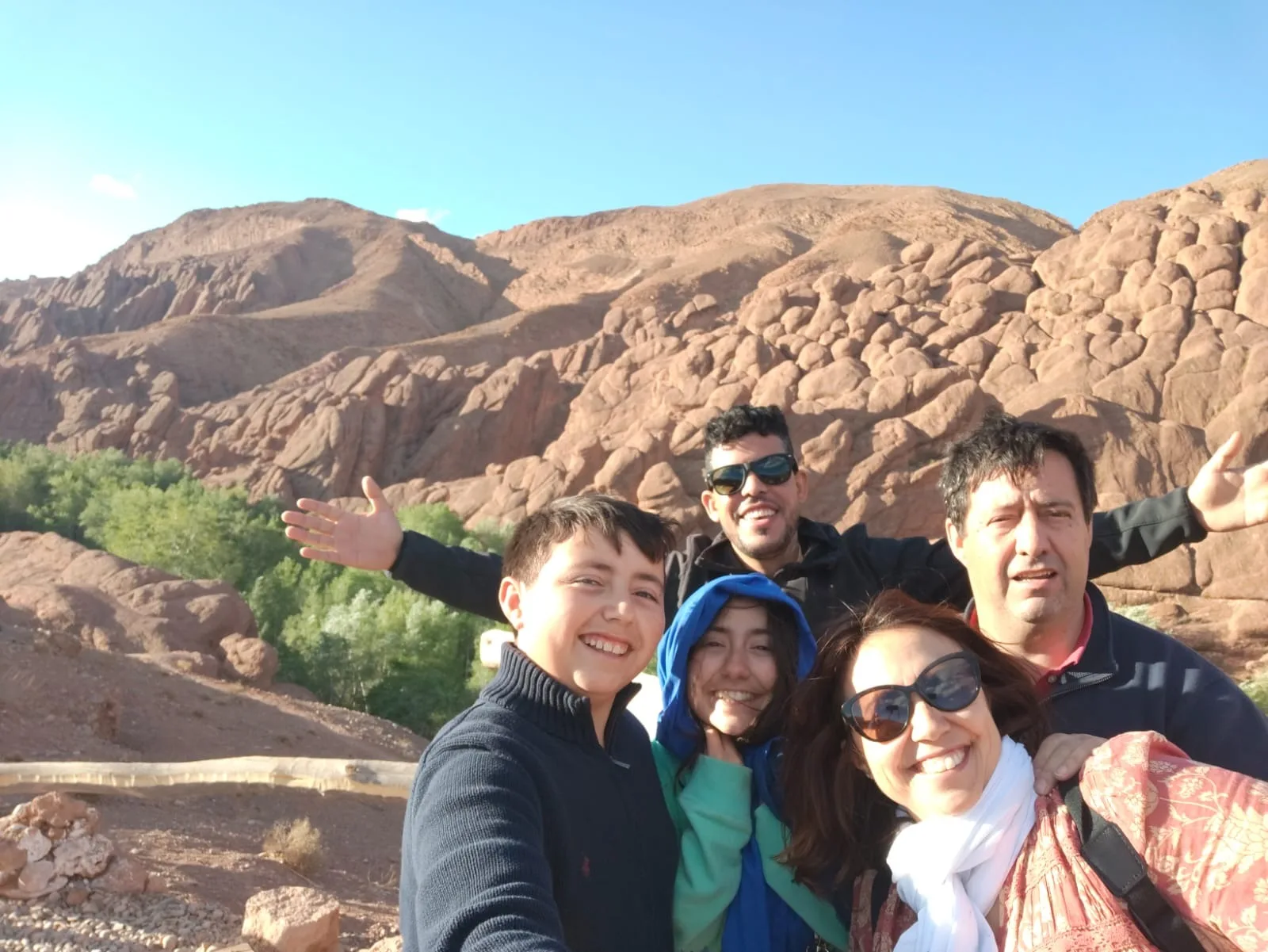
Todra Gorge, early
Limestone walls rising around 300 metres, narrowing until the road and the river share the gap. Go before ten. Later in the day the coaches arrive, the light drops out of the bottom of the gorge, and the stalls at the entrance get busy.
The road east and the Ziz palm groves
After Tinghir the landscape empties out. You pass the Ziz valley with its long ribbon of date palms, and then the country turns properly pre-Saharan — flat, stony, enormous. It is a long stretch with little to stop for, which is exactly why it works: by the time the first dunes appear on the horizon, you have earned them.
Camel trek into Erg Chebbi
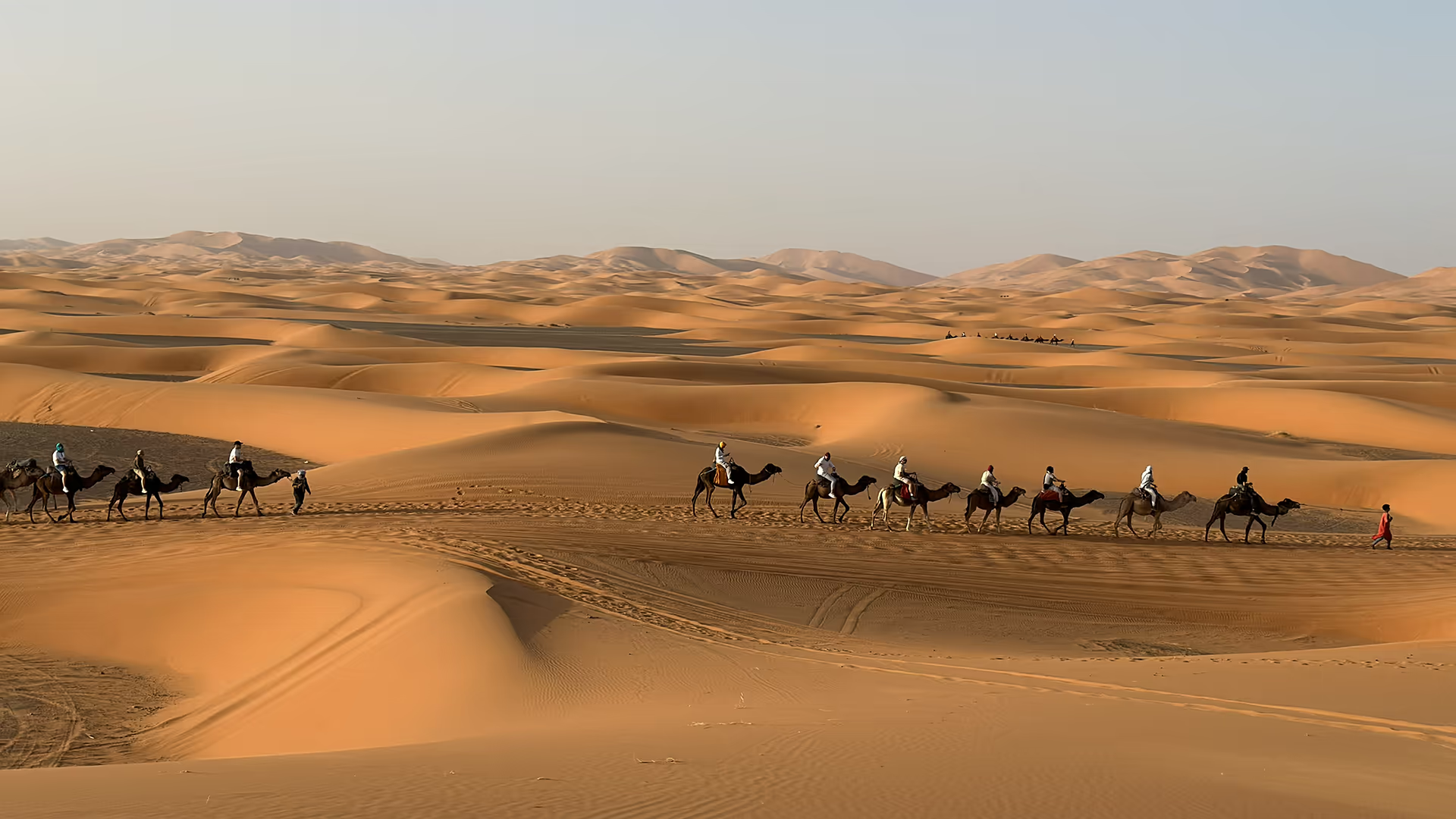
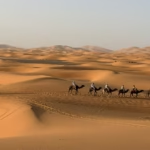
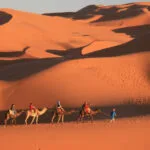
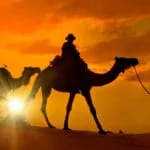
You reach Merzouga in the late afternoon, leave the big luggage, and go in by camel around an hour before sunset. Two honest notes: camels are not comfortable, and the trek takes about an hour. Nobody has ever told us it was not worth it. If you would rather not ride, we can take you in by 4×4 instead — just say so when we plan.
The night at camp

Our camp sits among the dunes with proper tents — a real bed, rugs, lanterns, an ensuite bathroom with hot water. Dinner is served outside, then there is a fire and drums for as long as you want them. After that it goes completely silent, and the sky is bright enough to read by. Bring something warm whatever the season; the temperature drops fast once the sun is gone.
Day 4 — Sunrise, Khamlia and the Road West
Sunrise over the dunes
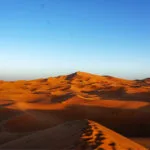
Worth the alarm. Walk up the nearest ridge in the dark and watch the sand change colour as the sun comes up. This is the photograph people actually keep.
Khamlia and the Gnaoua musicians
A small village south of Merzouga settled by descendants of West Africans brought north across the Sahara. The Gnaoua music played here — metal qraqeb, deep drums, call and response — is a genuinely different tradition from the Berber music at camp. It is a short stop and one of the more memorable ones.
The drive back
Then you turn west. This is the trade-off of a five-day loop that returns to Marrakech: day four is largely a driving day, retracing the route as far as Ouarzazate or Skoura. We break it with stops — the Skoura palm grove, a kasbah, the Rose Valley if it is April or May, when the harvest is on and the whole valley smells of roses.
If your flights let you fly out of Fes instead, we send you north from Merzouga through the Middle Atlas cedar forests and you skip this backtrack entirely. It is the better version of the trip.
Day 5 — Back Over the Atlas
A shorter morning: back over the Tizi n’Tichka to Marrakech, roughly four hours with a stop. We drop you at your riad or straight at the airport. If your flight is late, there is time for an argan cooperative on the way or a last hour in the souks.
Alternative: Starting from Fes Instead
Fes is our home city, and starting there changes the trip for the better if your flights allow it. You cross the Middle Atlas cedar forests, drop through the Ziz valley to Merzouga, spend your desert night, then continue west through the gorges to Ait Benhaddou and finish in Marrakech. Same highlights, no backtracking, and you get the two great imperial cities at either end. Details on our tours from Fes page.
What Changes the Price of a 5-Day Morocco Trip
We quote every trip from scratch rather than selling fixed packages, because the number moves with a handful of things. Knowing what they are helps you brief us properly:
- Season. Spring and autumn are peak. Mid-summer and deep winter are quieter.
- Standard of riad. A characterful small riad and a design or palace riad are very different propositions.
- Which desert camp. Standard tents, or an ensuite luxury tent with a private bathroom.
- Group size. The vehicle and driver cost the same for two people as for six, so the per-person figure drops as the group grows.
- Private or shared. Everything we run is private. Shared group departures are cheaper, and they are not what we do.
- Extras. City guides in Marrakech, a cooking class, a hammam, sandboarding or a 4×4 dune trip.
What is always in: the private vehicle and fuel, your driver-guide, accommodation and breakfasts, and the desert camp with the camel trek. What is not: flights, lunches and dinners outside camp, monument entry and tips. You get the full picture in writing before you pay anything. Tell us your dates and we will send a real itinerary and a price.
10 Things We Tell Every Guest Before This Trip
- Leave Marrakech by eight on day two. The Atlas crossing plus Ait Benhaddou is a long day and late starts ruin it.
- Do Todra before ten. After that the light is gone from the gorge floor and the crowds arrive.
- Pack a warm layer for the desert, in every season. Guests underestimate this one more than any other.
- Carry cash. ATMs are everywhere in Marrakech and scarce once you head east. Small notes are useful.
- Wear shoes you can walk on uneven stone in. Medina lanes, kasbah stairs, sand.
- Do not photograph people without asking. Especially performers on Djemaa el-Fna, who will ask for payment, and rightly.
- Haggle in the souk, not in a shrine or a home. In the souk it is expected and friendly. Elsewhere it is rude.
- Drink more water than you think you need. Dry heat hides how much you are losing.
- Ask your driver before Google Maps. Road closures, weather in the pass and market days do not show up online here.
- Tell us the awkward things in advance. Bad back, fear of heights, dietary needs, someone who cannot ride a camel — all easy to plan around, all difficult to fix on the day.
What to Pack for a Morocco 5 Day Itinerary
- A warm layer and something windproof for the desert night
- Walking shoes plus sandals
- Sun hat, high-factor sun cream, sunglasses
- A scarf — useful for sun, wind and blowing sand
- Modest clothing for medinas and villages: shoulders and knees covered is comfortable
- Cash in small notes, and a card for the cities
- A head torch for camp
- Any medication you need — pharmacies are good in cities, scarce in the desert
Best Time to Do This Route
March to May and September to November are the sweet spots — warm days, cool desert nights, comfortable walking in the medinas. July and August are hot inland, often past 40°C, and we time the desert around sunrise and sunset if those are your only dates. December to February is clear, bright and quiet, with genuinely cold desert nights and snow on the High Atlas. Our full month-by-month guide to visiting Morocco goes through it properly.
Frequently Asked Questions
Is 5 days enough for Morocco?
Yes, for one region done properly. Five days covers Marrakech, the High Atlas, Ait Benhaddou, the gorges and a night in the Sahara. It is not enough to add Fes, Chefchaouen or the coast — that needs eight to ten days.
What is the best 5-day route in Morocco?
Marrakech to Merzouga and back, via the Tizi n’Tichka pass, Ait Benhaddou, the Dades valley and Todra Gorge, with a night at a desert camp in Erg Chebbi. If your flights allow it, starting in Fes and finishing in Marrakech is better because it avoids retracing the route.
Can you reach the Sahara desert in 5 days?
Comfortably. Merzouga and the Erg Chebbi dunes are two days’ drive from Marrakech with sightseeing along the way, which leaves a full night and sunrise in the desert before you head back.
Should I go to Merzouga or Zagora on a short trip?
Merzouga. Zagora is closer to Marrakech but the dunes are much smaller. On a five-day trip you have the time to reach the real dunes at Erg Chebbi, and the difference is dramatic.
Do I need a guide for a 5-day Morocco itinerary?
You need a driver at minimum — the distances are long and the mountain roads demanding. We run everything privately with a driver-guide, plus local city guides in the medinas where they add most, like Marrakech and Fes.
Is the drive from Marrakech to the desert difficult?
It is long rather than difficult. The Tizi n’Tichka pass is a well-surfaced mountain road with a lot of bends, so bring something for motion sickness if you are prone to it. Days two and three are around seven and five hours on the road, broken up with stops.
What is the best time of year for this route?
March to May and September to November. Summer is very hot inland and winter nights in the desert are cold, though both are workable if we adjust the timings.
Can this itinerary start from Casablanca or Fes?
Yes. From Casablanca we usually add a night, since it is a longer run south. From Fes it works beautifully as a one-way route ending in Marrakech, with no backtracking.
Plan Your Five Days With Us
Tell us your dates, which airport you land at and what you most want to see from your Morocco 5 day itinerary, and we will send back a proper day-by-day itinerary — not a template. We are a family company: the person who answers your message is the person who plans your trip.
Get a free itinerary or message us on WhatsApp at +212 604 811 382.